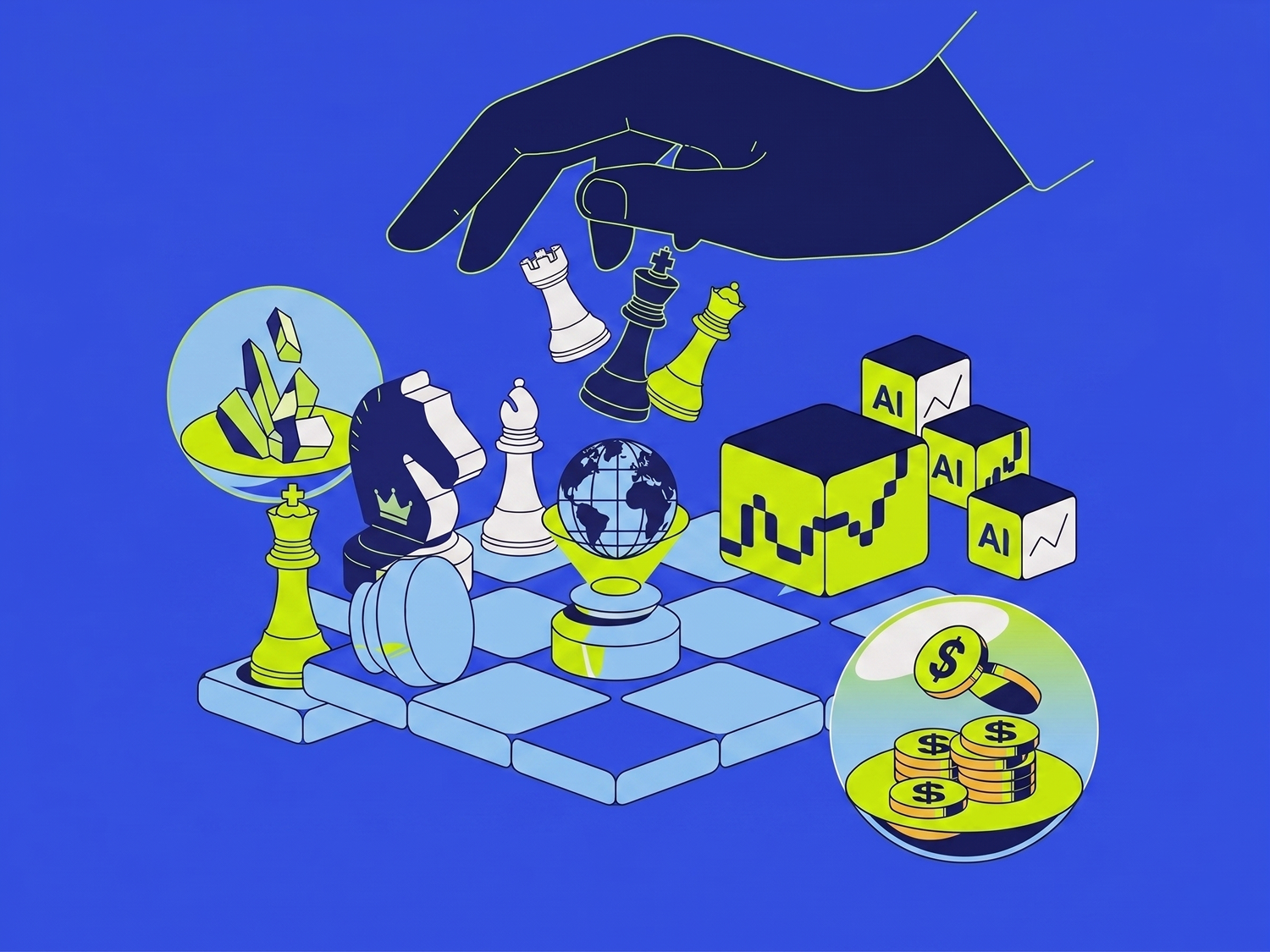
The Centaur's Arbitrage: What a Chess Tournament Reveals About the AI Arms Race
In 2005, two amateurs with no chess titles beat grandmasters and supercomputers by refusing to play chess. They managed chess engines instead. That distinction now matters for everyone.
Two Stories That Can't Both Be True
Building products as a Product Design Engineer, where AI is wired into daily prototyping and development, I keep running into the same unspoken dread. It's not about which framework to pick. It's about whether the person picking the framework will still have a job next year.
The anxiety splits into two narratives. The first is replacement: there's a fixed amount of work, and if an agent can do it cheaper than you, your market value drops to zero. The second is productivity: AI makes you ten times faster, so you'll produce ten times the value.
Both feel true simultaneously, which is why neither is useful. You feel the speed, but you also feel the floor shifting. To untangle this, I keep coming back to professional chess. Not because it's a perfect analogy for the economy (it isn't, and I'll get to why), but because it compressed decades of labor disruption into a few observable years.
What Actually Happened in 2005
In 1997, Garry Kasparov lost to IBM's Deep Blue. The takeaway seemed obvious: raw computation had overtaken human cognition, at least in this domain.
Eight years later, a freestyle tournament on Playchess.com tested that conclusion directly. The format was open: anyone or anything could enter. Supercomputers like Hydra competed solo. Grandmasters partnered with engines. The field included titled players rated over 2500, backed by serious hardware.
The winner was a team called ZackS. Steven Cramton, rated 1685, and Zackary Stephen, rated 1398. Both were amateur players from New Hampshire who hadn't competed since 1999. They used three commercially available chess engines running on consumer hardware. One of the computers was borrowed from a parent.
They didn't win by a fluke. They dominated from the qualifiers through the finals, beating grandmaster-computer teams and leaving Hydra behind. When people speculated they had a secret grandmaster feeding them moves, Kasparov himself confirmed they didn't.
Why Process Beat Intelligence and Compute
The popular retelling is that "amateurs + computers beat grandmasters + computers." That framing is catchy but imprecise, and the imprecision hides the real lesson.
The grandmasters weren't worse at chess. They were worse at managing engines. Kasparov wrote about this afterward: the strong players treated the computer as a subordinate, overriding its suggestions on gut feel. They played chess through the engine rather than with it. Their expertise became a liability. Years of pattern recognition made them second-guess the machine in precisely the moments they should have trusted it.
The standalone supercomputers lost for a different reason. Chess engines in 2005 (and to a lesser extent today) suffer from what's called the horizon effect: they evaluate positions brilliantly within their search depth, but can't see consequences beyond that boundary. In closed positions, where pawns are locked and there are no forcing sequences to calculate, the engine's power becomes useless. It will confidently evaluate a locked fortress as winning when any club player can see it's a dead draw.
Cramton and Stephen understood this. They ran three engines simultaneously, compared evaluations, and treated disagreements as signals of uncertainty. When engines converged, they trusted the output. When engines diverged, they intervened. They weren't playing chess. They were running a decision process about when to trust and when to override imperfect advisors.
The edge wasn't intelligence. It wasn't compute. It was knowing when the tools were reliable and when they weren't.
The Uncomfortable Economics
So far, this reads like a feel-good story about human-AI collaboration. It isn't one.
A recent paper by Hemenway Falk and Tsoukalas (UPenn / Boston University), titled "The AI Layoff Trap," formalizes something the chess analogy can't capture on its own: the competitive dynamics that make restraint impossible even when everyone sees the cliff ahead.
The model is blunt. When a company automates, it captures the full cost savings but bears only a fraction of the demand destruction. Lost wages reduce purchasing power across the entire market, but each firm absorbs only a sliver of that loss. The rest falls on competitors. So every firm has a dominant strategy to automate aggressively, even though collective restraint would make all of them more profitable. It's a prisoner's dilemma. Even if every CEO in a sector agreed to slow down, each would still have an incentive to defect. No voluntary agreement is self-enforcing.
The numbers are concrete. Block cut nearly half its 10,000-person workforce in early 2026. Salesforce replaced 4,000 customer-support agents with agentic AI. Over 100,000 tech workers were laid off in 2025 alone, with AI cited as a primary driver in more than half the cases.
The paper's counterintuitive finding: better AI makes the problem worse. When productivity increases, each firm perceives a market-share gain from automating faster than rivals. But at equilibrium, all firms automate equally, so the gains cancel and only the additional demand destruction remains. The authors call this the Red Queen effect. You run faster just to stay in place, and the collective running destroys the ground under everyone.
Where the Centaur Still Works
Against this backdrop, the centaur model is not a permanent solution. It's a window.
In chess, the freestyle era was transitional. By the time Stockfish and AlphaZero matured, human intervention became a bottleneck, not an asset. The centaur is extinct in chess. So why might the economic window stay open longer?
The economy has no fixed rules. Chess is an 8×8 board with deterministic outcomes. Business operates where the rules themselves change: regulations shift, preferences mutate, new markets appear from nowhere. An engine can master a closed system. No model yet handles genuine novelty, where the problem itself hasn't been defined.
Most valuable work is also cross-domain. In my job, the hardest part of building a product is never the code. It's the translation layer: understanding what a client's anxiety actually is (often not what they say), mapping that to a technical architecture, then making aesthetic judgments about how the result should feel. Current AI systems are strong within domains but weak at the seams between them.
And taste is still illegible. I can tell you a particular AI-generated interface feels generic, but I can't fully articulate why. That illegibility is the moat. The moment you can reduce a quality judgment to explicit rules, you can automate it. The judgments that resist formalization stay human for longest.
What I Actually Do Differently
Most articles on this topic wave their hands and say "become a strategist." That's useless without specifics.
When I'm building a prototype, I let the AI generate the initial component structure, the boilerplate, the responsive layout. I don't review that work line by line. It's reliable enough that auditing every bracket would waste my time. That's the equivalent of Cramton and Stephen trusting converging engines.
But when the AI generates a user flow, I slow down completely. This is where the models drift. They produce flows that are logical but emotionally flat. They optimize for task completion when the goal is trust-building. They treat every user as a rational agent moving through a funnel, when real people are hesitant, distracted, and looking for reassurance at specific moments. This is the locked position where the engine is confidently wrong.
The value I add isn't speed. It's error correction at the points where the model's confidence is highest and its judgment is worst. That's the centaur arbitrage.
The Window
The centaur window is real, but it has an expiration date. For some roles (writing SEO copy, triaging support tickets, generating standard legal documents) the window may already be closing. For others, roles that live at the intersection of multiple domains and involve high-stakes judgment, it's wide open.
The Hemenway Falk and Tsoukalas paper evaluates six policy responses to the automation trap. UBI, capital income taxes, worker equity: none of them change the per-task incentive to automate. The only instrument that works in their model is a Pigouvian automation tax, where revenue funds retraining that makes the tax self-limiting over time. Whether that's politically achievable is a different question. But the structural insight matters: competitive dynamics will push firms to automate faster than is collectively optimal. Counting on voluntary restraint is not a plan.
Cramton and Stephen won the 2005 freestyle tournament because they built a process that extracted maximum value from imperfect tools. They didn't play chess. They managed a portfolio of unreliable advisors.
That's the job now. Not forever. But while the tools are powerful enough to do the heavy lifting and unreliable enough to need supervision, the arbitrage is open. The question is whether you'll spend this window competing with the machine on calculation, or building the judgment that makes you the one it reports to.
The grandmasters who lost in 2005 had decades of expertise. It didn't help. What they lacked wasn't skill. It was the willingness to redefine their role.
Hemenway Falk, B. & Tsoukalas, G. (2026). "The AI Layoff Trap." University of Pennsylvania & Boston University. Available at arxiv.org/abs/2603.20617.